魔都
Restoration brings endangered egrets to China’s Yellow Sea coast_我的网站

A |
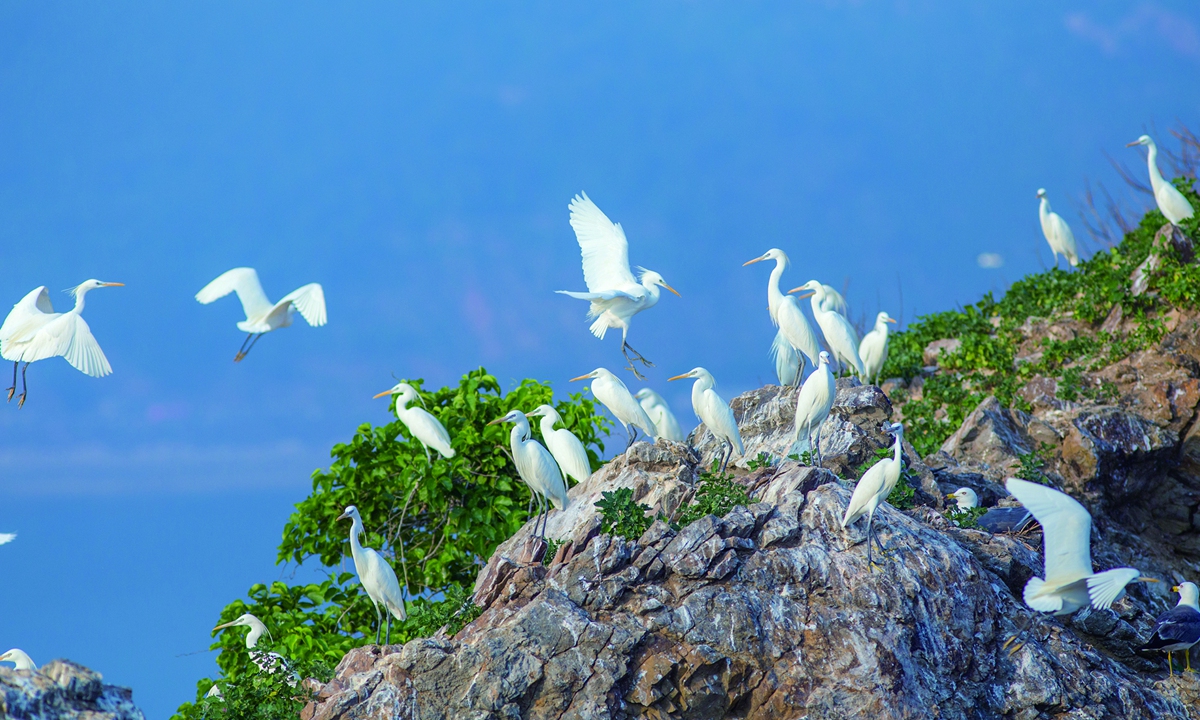
At 5 am, Wang Piyu, deputy director of the Changhai County Natural Resources Affairs Service Center, sets out by patrol boat for Fantuozi Island, a core breeding site for Chinese egrets in the Changshan Archipelago, Northeast China's Liaoning Province. The island has no permanent residents.
About 100 meters from the island, Wang turns off the engine and reminds accompanying researchers to keep their voices low to avoid disturbing the nesting birds.
Stepping onto the island, they walk along paths covered with vines. Scattered across the rocky slopes are nests measuring 40 to 50 centimeters in diameter. Inside, fluffy chicks huddle together among soft grass woven into nests, while adult birds perch high in the trees, watching cautiously.
"This was not what the island looked like 10 years ago," Wang recalled. "People used to collect eggs here, and coastal aquaculture polluted the tidal flats. Many parts of the island were bare, leaving little vegetation for birds to nest."
The recovery of Changshan Archipelago, however, has turned the remote archipelago into an important link in global conservation efforts.
At the 48th session of the UNESCO World Heritage Committee in Busan, South Korea, the boundary modification of the Migratory Bird Sanctuaries along the Coast of Yellow Sea-Bohai Gulf of China was approved, officially adding the Changshan Archipelago to the World Heritage site.
The expansion further strengthens the integrity of the serial natural heritage site, following a previous update in 2024, and highlights China's efforts to integrate coastal ecosystem conservation, according to the National Forestry and Grassland Administration.
Behind the World Heritage recognition lies years of conservation work involving local authorities and island residents.

Located in the northern Yellow Sea off Dalian, the Changshan Archipelago sits along a key route of the East Asian-Australasian Flyway, providing an essential stopover where tens of millions of migratory birds replenish their energy during their journeys across the Bohai Sea.
The newly added area covers more than 4,900 hectares and is home to more than 140 recorded bird species, including the Chinese egret and black-faced spoonbill, both listed as China's national first-class protected animals.
In 2015, more than 300 Chinese egrets arrived in Changhai county. After discovering the birds, local authorities introduced a series of protective measures, including establishing patrol teams and installing remote monitoring systems to reduce human disturbance.
However, the growing bird population also created new challenges.
Less than half of Fantuozi Island was covered by shrubs, which serve as the nesting grounds for the egrets. Additionally, the island's poor soil and acidification caused by years of accumulated bird droppings had led to the withering and death of some shrubs in recent years.
From 2022, the county launched an ecological restoration project, replacing surface soil with fertile earth and planting more than 2,200 shrubs.
The efforts helped restore the breeding habitat. The number of Chinese egrets on the island has since recovered, with this year's population estimated at about 3,500, including around 1,500 adults and nearly 2,000 chicks, according to Lü Yongquan, director of Changhai county's natural resources bureau.
"Chinese egrets are highly sensitive to water quality, vegetation and human disturbance. Their return to breed here is a sign that the marine ecosystem has recovered and is thriving," Lü told the Global Times.
From fishermen to guardians
Conservation in Changhai is not only carried out by authorities. Local communities have also gradually become part of the protection network.
Authorities have expanded public awareness campaigns and strengthened patrols. Because most of the Changshan Archipelago is uninhabited, drones, fixed-point infrared cameras, and on-site inspections are used to monitor the islands and reefs around the clock.
Many fishermen who once relied on the sea for their livelihoods now help protect it.
During the peak breeding season from April to July, regular marine patrols are carried out to protect nesting sites and prevent illegal egg collection and habitat damage. Local bird conservation groups and research institutions have also joined the efforts, while fishermen have taken on new roles as volunteer guardians of the islands.
Across Changhai county, many fishermen now actively participate in coastal patrols to help protect the archipelago's biodiversity.
For Li Qingsen, a 50-year-old island native and member of the county's forest fire brigade, protecting the birds has become a way of life.
From spring to autumn, 20 team members take turns staying on Fantuozi Island in pairs to protect the birds from disturbance.
Life on the 0.08-square-kilometer island is far from easy. There are no freshwater sources or docks. Patrol workers carry large barrels of water and wade ashore from boats anchored offshore. Instant noodles are often their main food because they require little preparation and some water.
Their work is closely tied to the seasonal cycle of the birds. Each April, thousands of Chinese egrets arrive in the archipelago from Southeast Asia to breed and rear their young, staying until early September before migrating south for the winter.
At present, young egrets are already practicing flight above the treetops. By autumn, they will join their parents in a southward migration.
For Wang, who has spent half of his life guarding Fantuozi Island, the World Heritage recognition is both a homecoming for the birds and a reward for years of protection. "Now, it is a home for the birds, and a reward for all the years we have spent protecting it."
。据外媒1月11日报道,联想在CES上展示了两款点滴显示屏,分别为Legion Y44W和Thinkvision P44W,分辨率为3840*1200。它们分别是游戏和办公设计。

B | 撘legion Y44W撘thinkvision P44W legion Y44W和thinkvision P44W显示器使用分辨率为3840 x 1200、亮度为450 nit的43.4英寸面板。这两个LCD屏幕具有VESA的Dislay HDR 400认证,因此支持HDR 10格式。两台显示器配有两个USB 3.1第1代和第2代C型端口,提供90 W(两个端口)输出,并连接两台PC,这在家庭和办公环境中都很有用。主要游戏体验Legion Y44W支持AMD Freesync 2 HDR,最大刷新率为144赫兹,响应时间为4毫秒。此外,它还有一个可移动的Harman Kardon认证扬声器。相比之下,以生产力为中心的Thinkv iSion P44W显示器集成了KVM交换机,允许在一台显示器上无缝使用两台PC。

C | 联想指出,分辨率为3840 x 1200的43.4英寸面板可以提供与两个分辨率为1920 x 1200的24英寸显示器相同的屏幕空间(和像素)。Thinkvision P44W液晶显示器采用比较保守的设计,与办公环境的设计相匹配。这两款显示器将于4月份开始销售,Legion Y44W售价1200美元(8100元),Thinkvision P44W售价1300美元(8800元)。
Current article:http://www.diaoengngtengdiachanpiezao.sbs/ga83/20260826/73901.xlsx
Published on:07:09:55
 西门无恨
西门无恨 来自星星的你
 新视觉
新视觉 同桌的你
同桌的你 假装情侣
假装情侣 大器晚成
大器晚成 血战太平洋
血战太平洋 战争之王
战争之王


