俄罗斯老人奥尔加·波格丹诺娃,是一位96岁的二战退伍军人,勇敢对抗纳粹的斗士,竟被揭露在过去15年间遭受非人待遇,被邻居加林娜·巴拉什涅娃囚禁并剥夺了她的养老金,金额高达212万卢布。

B | 这一骇人听闻的秘密在奥尔加心脏病发作送医后终于浮出水面,引起了全国的震惊。
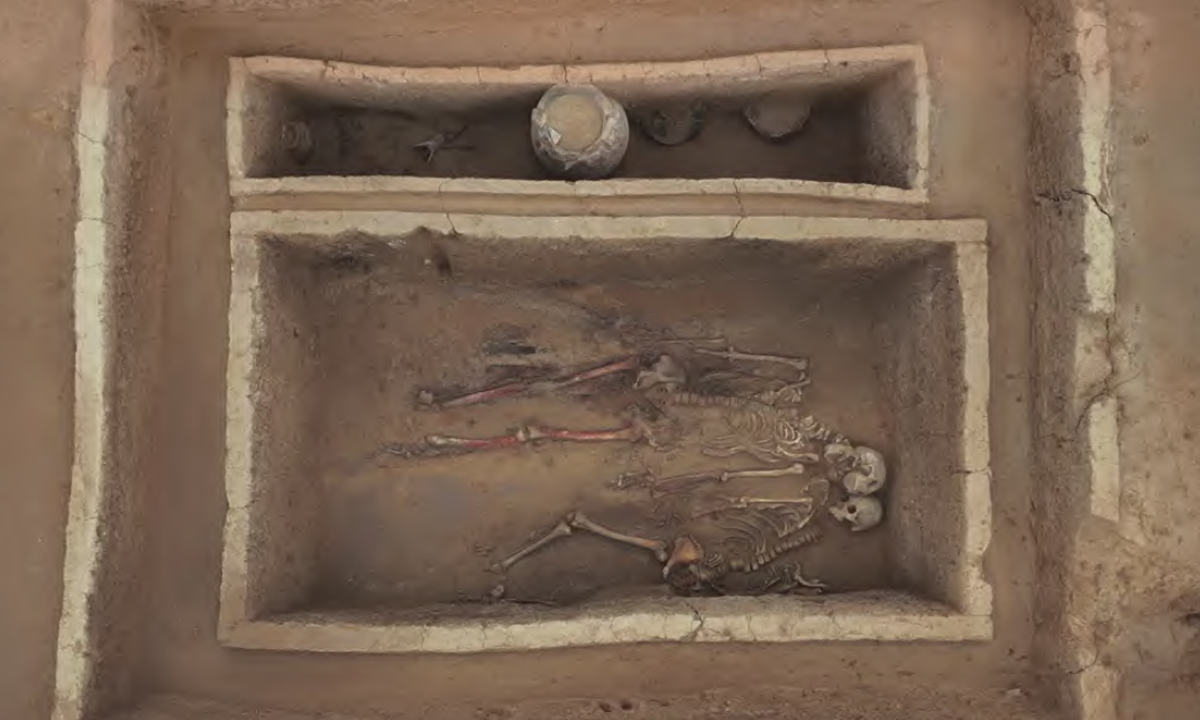
Coffin chamber M13 Photo: Courtesy of the Shanxi Provincial Institute of ArchaeologyThe highest-ranking noble cemetery complex from the late Xia Dynasty (c.2070BC-c.1600BC) ever discovered has been unearthed at the Zhongcun site in North China's Shanxi Province, expanding research on Xia and Shang (c.1600BC-1046BC) civilizations and early state formation in ancient China, according to a press release that the local institute of archaeology sent to the Global Times on Monday.
Located on a hilly terrace west of the Taihang Mountains and flanked by the Songxi River, the site was excavated in 2024 and 2025 by the Shanxi Provincial Institute of Archaeology and partner institutions, leading to the discovery of 18 tombs, including six Xia Dynasty burial sites and 12 Warring States Period (475BC-221BC) graves.
"These are the highest-ranking Xia aristocratic tombs discovered so far, indicating that this location was a regional center," the institute said.
The Xia Dynasty is traditionally regarded as China's first hereditary dynasty, though contemporaneous written records are lacking.
The well-organized Xia tombs, concentrated in the western part of the cemetery, feature uniform east-west oriented vertical earthen pits. Researchers recovered nearly 40 sets of artifacts with distinctive local cultural characteristics, including pottery, lacquerware and turquoise ornaments.
Extended regional surveys across the Songxi River valley yielded more than 10 Xia and Shang period sites. Test excavations at nearby relic sites unearthed pottery fragments, stone tools, bronze knives, as well as tin-bronze ingots and smelting residue, providing solid evidence of early metal mining and craftsmanship.
Local copper-iron symbiotic ore deposits confirm exploitation of these resources during the Xia and Shang eras, while typical cultural artifacts found in adjacent counties reveal widespread regional cultural exchange.
Multidisciplinary analyses further decoded the civilization's features. Ancient human remains belong primarily to the ancient population of the Central Plains with minor Mongolian Plateau genetic traits, forming a stable patrilineal clan. The community relied on millet farming and maintained long-distance resource trade networks.
Artifact provenance tests trace scallop shell ornaments to the Bohai Sea, cinnabar to Hunan-Guizhou ore belts, turquoise to the eastern Qinling Mountains area, and coffin timber to local Taihang pine trees. Such diverse materials reflect close interaction among the Taihang foothills, the press release noted.
Lab restoration unveiled refined ritual relics, including a dragon-patterned lacquer cylinder with red and black stripes and an intact lacquer gu vessel (a type of wine vessel). Turquoise plaques from the site match specimens from the Erlitou site, a core Xia cultural relic, proving cross-regional cultural interaction. Radiocarbon dating places the site's active period between 1880BC and 1450BC, aligning with the late Xia Dynasty.
Scholars confirmed the findings have helped reshape academic understanding of Xia-Shang civilizations and reconstruct multi-level settlement patterns on the western Taihang foothills, while offering new insights into social complexity and civilization development in early China.
。
一段由国家电视台播出的片段揭示了奥尔加的苦难,促使斯摩棱斯克地区的执法机关迅速介入。镜头中的奥尔加被发现在一片狼藉的房间中,床铺残破,墙纸斑驳,她仿佛被时间遗忘。而涉嫌罪犯巴拉什涅娃已被捕,同样在冰冷的牢房内接受法律的质询。
奥尔加的住所犹如荒废之地,陈旧的炉灶尘封已久,窗户以塑料袋代替玻璃,严冬中仅靠零星的衣物和薄毯抵御寒冷。斯摩棱斯克州高级助理检察官尤利娅·卡扎科娃宣布,此案因涉及诈骗、非法监禁及将战争英雄置于危险境地而正式立案,目前调查工作正在进行中。
此外,近期另一起匪夷所思的事件也震惊社会:一女子企图将亡者带入银行,意图冒领高额贷款。银行员工机敏应对,录像存证并报警,女子在试图让逝者“签字”时被制止。警方到场后,确认68岁的保罗·罗伯托·布拉加已逝世数小时,而涉事女子埃里卡·德·索萨·维埃拉·努内斯谎称为其侄女兼看护,目前正接受警方调查。