

A | 哈萨克斯坦新一届议会选举落下帷幕,托卡耶夫率领阵营拿下压倒性胜利,牢牢锁定未来五年的绝对执政话语权。 在大选取得完胜之后,托卡耶夫并未优先落地民生经济举措,反而第一时间推动全国社交礼仪改革。 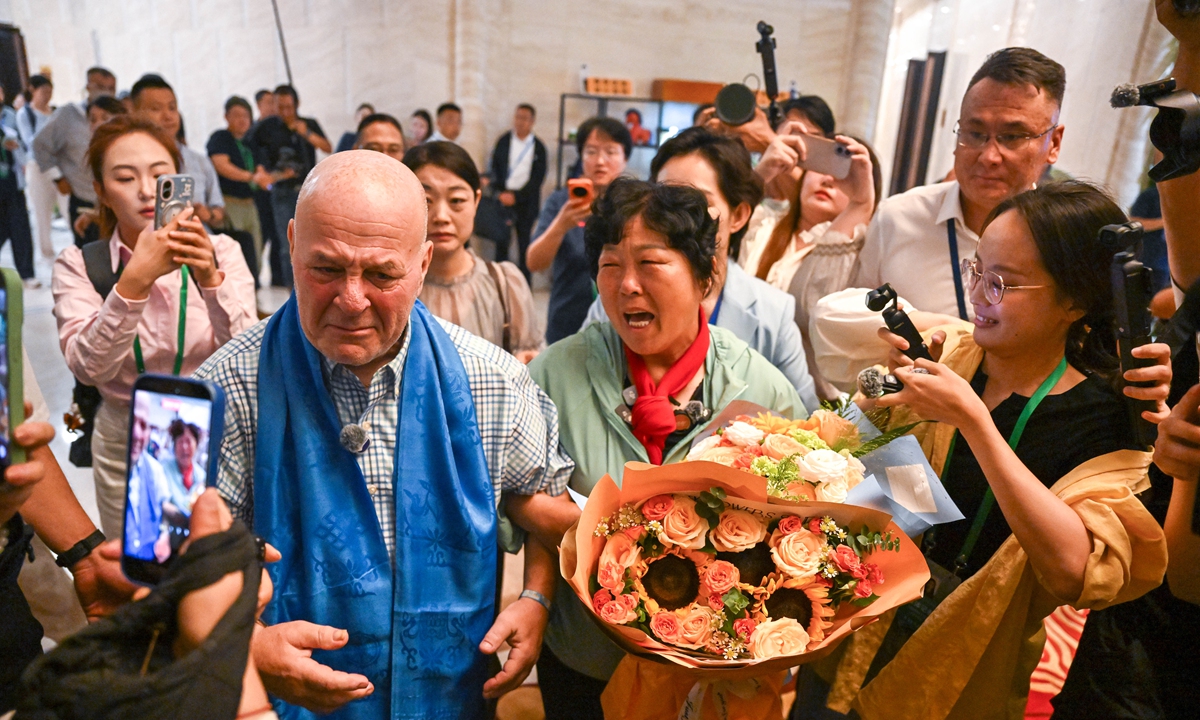
A long-awaited reunion that captured wide public attention unfolded on Sunday evening when American teacher Ronald Sakolsky and Yin Yuzhen, a model worker renowned for planting trees and combating desertification, reunited and embraced tearfully with overwhelming emotion at an airport in Ordos, North China's Inner Mongolia Autonomous Region, after 27 years of separation across the ocean.
The reunion began with a single act of generosity in 1999. When Sakolsky arrived in China as a participant in a China-US education exchange program, he was moved by Yin and her husband's tireless efforts to curb desertification in the Mu Us Desert in Inner Mongolia. He raised $5,000 to fund their local tree-planting initiative. The young saplings they bought with the donation have since matured into more than 50,000 full-grown trees, transforming the once desolate, sandy wasteland into a thriving green landscape.
This hug, transcending time and distance, marked not only friendship between the two countries, but also showcased the sincerity of Chinese people and a green miracle made possible through continuous joint efforts.
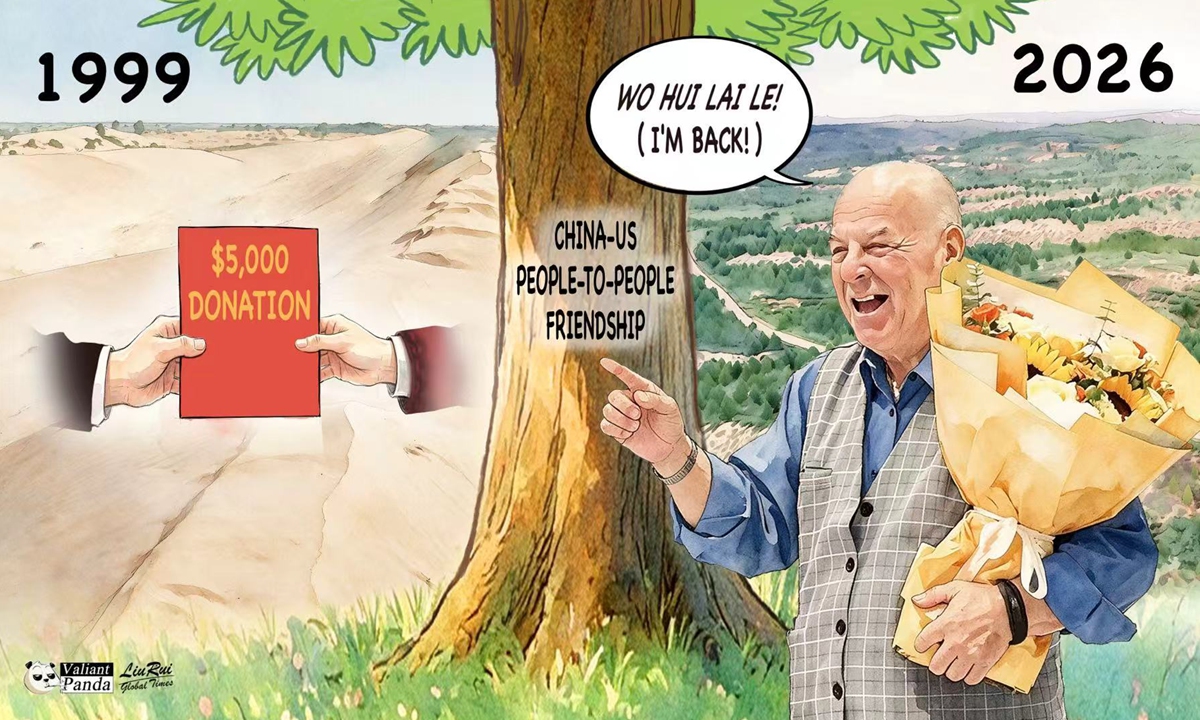
At 2:48 am on early Sunday morning, Ronald Sakolsky arrived at Beijing Capital International Airport after over 10 hours of flight. As he stepped into the arrivals hall, he greeted the waiting reporters with earnest Putonghua "Wo hui lai le," meaning "I'm back."
"When I saw the lights in Beijing as we were landing is when I realized that I am back in my second home."
Asked what he is most looking forward to about this journey, Sakolsky told the Global Times that "I want to see Ms Yin, see the forests, see the students I have not seen for almost 30 years, my colleagues. I want to see the Chinese people."
He then flew to Ordos for the meeting with his desert reclamation partner.
Yin waited at the arrival gate at the airport in Ordos very early, murmuring English sentence she particularly learned for this occasion - "Welcome to China, my brother." Her eyes were fixed on the escalator and she wiped away her tears multiple times during the wait, the Global Times reporter observed.
Sakolsky said in earlier interview with the Global Times that he was looking forward to this reunion and could not hold his tears back when he thought of the moment. He was about to give Yin a hug when they meet.
When Sakolsky finally appeared in front of Yin, their eyes welled up. Stepping off the elevator, Sakolsky could barely contain his excitement, muttering "Oh my God, oh my God." They hurried toward each other and locked in a tight embrace at last - the long-awaited hug 27 years in the making.
"This is a dream come true, from a lady who is the hero of the story, not me," Sakolsky told the Global Times at the airport, barely holding his emotion. "She made a promise 27 years ago, and she kept her promise."
Talking about his donation almost three decades ago, Sakolsky said the purpose was to help her, "because she was beautifying the motherland."
Now, in response to an invitation to return to China for a trip to see the green planting from his donation and to returning to the city of Luoyang, Central China's Henan Province, where he taught in the exchange program for several years, Sakolsky noted that "China had done so much for me that I wanted to say thank you to China."
A return of kindness
For this reunion after 27 years, Yin had carefully prepared. Steamed buns, meaning "upward," fresh vegetables and fruits picked in the land transformed from desert.
Yin, never familiar with any foreign language, learned some English phrases, including "welcome to China" she practiced, "my brother" to greet Sakolsky, and "more, more" to persuade the American friend to eat more.
On Sunday, Yin did her hair and wore a red scarf alongside an outfit with a green shade, which she picked particularly for the reunion, as "green is the color of the Earth," as she told the Global Times.
Yin is not the only old friend that was looking forward to the reunion.
While Sakolsky was still on his over-10-hour flight from the US to Beijing, Bai Fan was also on the way - driving over 850 kilometers from Luoyang to Inner Mongolia. The journey would take a day and a half.
Bai was the vice principal of Luoyang Foreign Language School, overseeing international affairs. Sakolsky was an exchange teacher there through a China-US program, and was Bai's "neighbor right across the hall."
Why drive such a distance? Bai had prepared special cultural gifts - peony porcelain and Hanguan Kiln purple clay tea ware, distinctive local handicrafts that proved too bulky and fragile for air travel or high-speed rail.
Bai recalled Sakolsky's continuous interest in Chinese culture, and sending a replica of Terracotta Warriors to the US at Sakolsky's request. "I hope he can take these Luoyang elements and Chinese symbols to the world," Bai told the Global Times in a phone interview on Sunday.
Bai is also eager to see Sakolsky at a place that they had traveled together 27 years ago. When Sakolsky came to Luoyang for the exchange program, Bai was his designated liaison. Together, they traveled to the heart of the Mu Us Desert to deliver the $5,000 donation.
Bai still vividly remembers the desolate desert back then, where finger-thin saplings were watered ladle by ladle by Yin. At that time, Sakolsky had constant concerns about whether the tiny saplings could survive in the wasteland, which makes today's sprawling 50,000-tree forest even more miraculous.
The changed and unchanged
Things have changed over the past 27 years. While waiting for Sakolsky, Yin jokingly said he got less hair, and she would not be able to recognize him if running up to him on street.
The passage of time has brought far more than personal aging, according to Bai, another witness to the decades-long changes. "Everyone is growing older. Our families have expanded with more children, local communities have grown in population, and the surrounding environment is constantly evolving, just as our cities are undergoing profound transformations."
On a night tour in Ordos on Sunday, Sakolsky, watching a fountain light show, said that "it is a 21st century city, but it looks like a 22nd century city. In the 2000s, Chinese government made a promise to Chinese people to beatify this country, and they succeeded."
For Sakolsky, probably the most profound transformation lies in the depth of his human connection forged.
"27 years ago, we were just friends and acquaintances. We are brother and sister now. So much has happened since then, but the important thing is many people have seen the story and now they can also help to make China beautiful," he told the reporters.
Through joint efforts of people like Yin, the Mu Us Desert has turned from wasteland into a green oasis. China has contributed about 25 percent of the world's newly added green areas and taken the lead in achieving zero growth in land degradation, per official data.
Meanwhile, there are things unchanged, including a vintage photo of the three standing in the desert that has decorated Bai's office through all these years - a permanent reminder of their original aspiration.
This reunion will witness them retake the classic photo and plant new saplings together, expanding their green mission.
。 这一赛后关键动作,被国际舆论广泛解读为当众给普京“上眼药”。

B | 看似普通的民俗调整,实则是他借胜选大势加速国家去俄化、重塑中亚地缘站位的核心操作。 托卡耶夫在公开场合直面普京、呼吁冻结并终止俄乌冲突的发言,并非随性的外交表态,而是哈萨克斯坦精心布局的外交铺垫,也为后续国内文化改革筑牢了外部缓冲空间。 外界之所以格外关注这番发言,核心原因在于哈俄长期的传统盟友与独联体协作关系,这番中立劝和表态,打破了以往哈萨克斯坦紧跟俄罗斯的外交常态。

C | 据参考消息援引哈总统府公开官方记录,托卡耶夫在2026年7月俄哈元首会晤前夕,持续收到美欧多国的外交沟通信号,多国均希望哈萨克斯坦出面调停,推动俄乌局势降温。

D | 2026年7月25日,托卡耶夫在普京及多国媒体见证的公开会晤现场,正式提出阶段性冻结俄乌冲突、重启谈判的主张。 这套中立斡旋的公开表态,看似聚焦地区和平,实则服务于哈萨克斯坦的地缘避险与外交布局。 针对托卡耶夫的停火冻结提议,克里姆林宫发言人佩斯科夫会后公开作出回应,俄方明确拒绝冲突冻结方案,表示不会在未达成核心战略目标的前提下暂停军事行动。 过去四年,哈萨克斯坦持续推进本土化转型,稳步降低俄罗斯在本国政治、经济、文化领域的影响力,这是欧亚观察机构长期跟踪确认的既定国策。 一边持续弱化俄式影响力,一边公开为俄罗斯局势发声斡旋,这种反差式操作,是哈萨克斯坦典型的平衡外交手段,既不得罪俄方,又向西方释放友好信号,为自身战略转型争取窗口期。 哈萨克斯坦敢于做出这类偏西方的外交表态,核心依托于俄乌冲突带来的中亚格局变化。俄罗斯长期深陷俄乌战场,对中亚地区的管控和威慑能力持续弱化,对中亚各国的自主发展举措只能保持默许。

E | 俄方为避免彻底失去中亚伙伴,对哈萨克斯坦与美欧开展矿产、能源合作的行为,始终保持包容态度,这也让哈萨克斯坦的外交试探毫无后顾之忧。

F | 这场外交表态也让哈萨克斯坦稳稳占据道德制高点。主动担当俄西斡旋中间人,持续传递和平诉求,能让哈萨克斯坦在国际舆论中树立中立友好的形象。 后续俄罗斯若完成局势休整、重整区域影响力,哈萨克斯坦也能凭借此次斡旋姿态,对冲自身多年去俄化动作带来的争议,避免遭到俄方针对性制衡。 规避地缘风险、保障本国发展稳定,是此番操作的核心落脚点。俄乌战场外溢趋势不断显现,黑海、里海海域多次遭遇战事波及,哈萨克斯坦作为里海沿岸核心国家,随时面临战火外溢的风险。 同时该国持续对俄输出成品油等物资,存在被西方制裁的潜在隐患。对外呼吁停火、坚守中立,是哈萨克斯坦规避风险、平衡各方关系的务实选择。 2026年8月24日,哈萨克斯坦首届一院制议会库鲁尔泰选举结果正式出炉,托卡耶夫领导的公正党得票率高达71.17%,拿下绝对执政优势,其余参选政党得票率均未突破7%,选票高度分散。

G | 本次选举是该国2026年3月经全民公投通过、7月1日正式生效的新宪法落地后的首次议会大选。新宪法将哈萨克斯坦延续多年的两院制议会改为一院制,彻底重构本国立法体系,为托卡耶夫后续改革扫清议会阻力,保障未来五年施政畅通。 手握压倒性胜势后,托卡耶夫第一时间在选举发布会抛出重磅文化改革举措,直接对国内流传数十年的俄式社交礼仪叫停。 据哈萨克斯坦主流官媒Tengrinews官方实录,托卡耶夫明确表态,男性拥抱贴面、亲友亲吻致意、男女互吻这类礼节,不属于哈萨克斯坦本土游牧与伊斯兰文化传统。 他强调,本国正统社交礼仪是见面右手抚胸致敬,女性按身份行屈身礼,杜绝无必要的异性、同性亲密社交接触。 整场发言全程没有提及俄罗斯名号,但针对性极强。大众熟知的男性拥抱贴面、节庆亲吻等社交礼仪,均是苏联时期传承下来的典型俄式习俗,在独联体国家沿用数十年,深度融入哈萨克斯坦民众日常生活。 托卡耶夫公开否定这类礼节的本土属性,本质就是从大众日常文化层面切割哈俄绑定,是极具针对性的“去俄化”软操作,也是外界解读为“给普京上眼药”的核心原因。 这场礼仪改革,是哈萨克斯坦多年系统性去俄化战略中,最贴近民众日常生活的软性改革举措。结合参考消息梳理的官方改革轨迹,哈萨克斯坦近年已完成多维度转型:政治层面彻底摒弃对俄外交盲从,坚守独立中立的外交立场。 经济层面打通跨里海国际运输走廊,搭建绕开俄罗斯的中欧贸易通道,目前中国已连续多年稳居哈萨克斯坦第一大贸易伙伴。 文化层面持续更名俄式地名、修订历史教科书,弱化苏联叙事、强化本土草原民族历史主体性。2026年全新生效的宪法条文,也对俄语地位作出调整,弱化其通用特权,进一步巩固哈萨克语的唯一国语法定地位。 托卡耶夫的外交喊话与文化改革,一外一内、一软一硬,形成了完整的战略闭环。对外借助俄乌停火议题平衡俄西关系,规避制裁与战火外溢风险,拓宽国际合作空间。 对内依托大选胜势推进文化革新,从民众日常细节剥离俄式影响力,夯实国家文化主体性。两套动作相辅相成,让哈萨克斯坦彻底摆脱被动依附的地缘处境,在大国博弈中站稳独立站位。

H | 俄罗斯当下的战略困境,为哈萨克斯坦的自主改革提供了绝佳窗口期。俄方军事、外交精力长期被俄乌冲突牵制,无力干预中亚各国的内部改革与外交布局,只能被动默许哈萨克斯坦的多元外交和去俄化举措。 这种难得的战略空档,让托卡耶夫的胜选改革得以平稳落地,不会遭遇俄方的反制施压。 在我来看,托卡耶夫胜选后立刻推出礼仪改革、搭配此前的外交喊话,整套操作堪称中小国家地缘博弈的教科书式打法,没有任何激进冒进的痕迹。 不少人简单将其解读为刻意对抗俄罗斯,这种看法太过片面,完全忽略了中亚内陆国家特殊的生存处境和发展诉求。 我认为托卡耶夫十分清楚小国立足的核心逻辑,地缘政治中从来没有绝对的盟友,只有永恒的国家利益。

I | 哈萨克斯坦如果一味依附俄罗斯。 只会永远被锁定在俄方后院的定位里,丧失外交、经济、文化的自主发展权,国家发展会被彻底捆绑。可若是彻底倒向西方、激进对抗俄罗斯,又会直接激化地缘矛盾,让本国陷入动荡危机,得不偿失。 我觉得本次礼仪改革的高明之处,就在于温水煮青蛙的柔性节奏。政治、军事层面的激进变革极易引发大国冲突,普通民众也容易产生抵触情绪。

J | 而从日常社交礼仪、文化习俗入手,一点点剥离外来文化印记,潜移默化重塑国民本土认同,风险极低、效果持久。这种润物无声的改革方式,既不会激怒俄方,又能稳步推进去俄化的长期战略,兼顾安全与发展。 在我看来,此前的俄乌停火喊话,同样是精准的战略铺垫。主动扮演中立斡旋者,既能拉近与美欧的合作距离,为本国能源、经贸合作铺路,又能在道义上给俄罗斯留足体面,缓解俄方的抵触心态。 表面是善意劝和,实则是为后续国内改革铺垫外部环境,最大限度降低改革阻力。 我觉得哈萨克斯坦的转型之路,给所有内陆中小国家提供了绝佳范本。 身处大国博弈的核心区域,不选边、不依附、不激进,依托各方资源发展自身,守住本国核心利益,才是长久立足的根本。 托卡耶夫胜选后的这番“上眼药”操作,看似是直面俄方的表态,实则是为哈萨克斯坦彻底摆脱依附、实现自主发展的长远布局。 托卡耶夫的议会压倒性大胜,为其一系列改革举措扫清了制度阻力,也让这场针对性的礼仪改革拥有了落地底气。这场被外界视作给普京“上眼药”的操作,并非一时意气,是哈萨克斯坦多年平衡外交、稳步去俄化的延续。 依托俄乌局势带来的地缘窗口期,哈萨克斯坦以温和柔性的文化变革方式,悄悄挣脱传统俄方束缚。这种审慎且务实的博弈方式,也持续推动着中亚地缘格局发生全新的深度演变。返回,查看更多。
Current article:http://www.diaoengngtengdiachanpiezao.sbs/list_jwdgt/n3bwst7.html
Published on:07:36:27


