夫妇飞美国打儿媳
SL rehabilitation law criticized_我的网站

A |
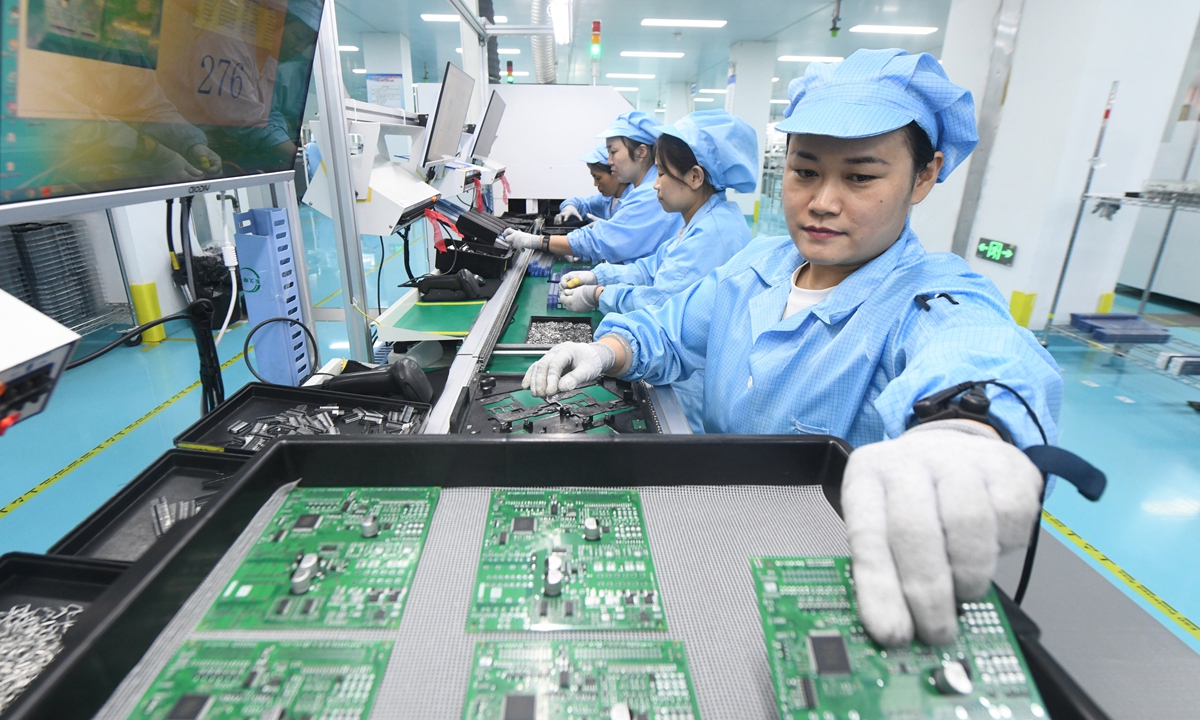
Workers produce electronic components for exports at a factory in Xinle, North China's Hebei Province, on June 16, 2026. Photo: VCG
China's exports of integrated circuits (ICs) reached $216.02 billion in the first seven months of 2026, up 99.5 percent year-on-year, according to data released by the General Administration of Customs (GAC) on Friday.
Chinese experts said that rising global artificial intelligence (AI) demand is a factor, but the main drivers of the leap in chip exports are the country's technological breakthroughs and upgraded industrial chain.
The robust growth in IC exports also came as China's overall foreign trade saw stable expansion. According to data released by the GAC, the sound upward trend in China's foreign trade continued in July, with growth of 19.2 percent year-on-year to reach 4.66 trillion yuan ($686.26 billion), remaining above 4 trillion yuan for the fifth consecutive month.
In the first seven months of the year, total foreign trade in goods amounted to 30.13 trillion yuan, up 17.3 percent year-on-year, the data showed.
"Since the start of this year, China's economy has forged ahead against headwinds and moved toward innovation-driven, higher-quality development, providing strong underpinning for the growth of foreign trade," said Lü Daliang, an official with the GAC.
According to the GAC, China's exports of electromechanical products reached 11.12 trillion yuan between January and July, up 21.2 percent year-on-year. They accounted for 63.8 percent of the country's total exports, up 3.8 percentage points on a yearly basis.
There was notable progress in green and low-carbon products, with exports of electric vehicles (EVs) and lithium batteries rising by 71.2 percent and 35.8 percent, respectively, while exports of 3D printers soared by 110 percent, with industrial robots jumping 13.2 percent and ships 32.7 percent.
"The surge in China's chip exports reflects breakthroughs in multiple aspects," Fu Liang, a Beijing-based tech analyst, told the Global Times on Friday. Fu pointed to a rise in mature-node capacity, industrial and supply chain resilience, and scale production advantages of Chinese companies.
As demand for chips in automotive electronics, industrial control systems, and household appliances keeps rising, China-made mature-process chips - backed by reliable supply capability and strong cost-performance - have become an indispensable link in the global supply chain, Fu said.
Meanwhile, there has been an upgrade in China's chipmaking industry, such as the new chip design approach at Huawei based on the company's Tau Scaling Law, and the international competitiveness of China-made chips is expected to increase, supporting further growth in exports, the expert noted.
China recently issued a revised regulation on protection of IC layout-designs. Scheduled to take effect on October 15 this year, the regulation aims to strengthen the protection and application of layout-designs, and improve registration and management systems by elevating proven practices into regulations, while also aligning with relevant laws and international treaties.
These institutional upgrades are unfolding alongside broader efforts to expand domestic demand and open the Chinese market wider to the world. China has also accelerated imports in the first seven months of this year to promote a more balanced development of foreign trade. China has remained the world's second-largest import market for 17 consecutive years. In the first seven months of 2026, China's import growth outpaced export growth by 8 percentage points, according to the GAC.
In addition, China's imports and exports with over 180 countries and regions registered growth over the period. Specifically, the country's trade with ASEAN, the EU, Latin America, and Africa rose by 20 percent, 9.5 percent, 15.4 percent, and 18.9 percent year-on-year, respectively. Trade with the US, however, fell by 1.6 percent, with the decline narrowing by 2 percentage points compared with the first half of the year, according to the GAC.
Amid a complex external environment, China has leveraged its complete industrial chain to accelerate trade structure upgrading, driving brisk growth in both imports and exports, Wen Bin, chief economist of China Minsheng Bank, told the Global Times.
Although China's foreign trade sector still faces pressure in the second half of the year, Wen said the same fundamentals are still supporting China's export growth: the competitiveness of China's "new new three" products, the ongoing AI investment cycle, plus a raft of domestic risk-mitigation policies covering forex, fiscal and customs.
"China's export sector is projected to hold onto double-digit growth in the second half of the year," he said.
。 Colombo, Oct 17 (UNI) The Sri Lankan government should withdraw a draft law that will give the authorities broad powers to detain people in military-run “rehabilitation” centers, placing them at great risk of abuse, Human Rights Watch (HRW) has said.
The HRW said the Bureau of Rehabilitation Bill, submitted to Parliament on September 23, would allow the compulsory detention in centers of “drug dependent persons, ex-combatants, members of violent extremist groups and any other group of persons”, the Daily Mirror reported on Monday.
“The Bureau of Rehabilitation Bill would establish a new administrative structure controlled by the Defense Ministry to operate 'rehabilitation' centers staffed by military personnel.
"The proposed law, which human rights advocates have already challenged in the Supreme Court, does not describe the basis for being sent for 'rehabilitation' but other recent government policies provide vague and arbitrary powers to forcibly 'rehabilitate' people who have not been convicted of any crime,” the HRW said.
“The Sri Lankan government’s proposed ‘rehabilitation’ efforts appear to be nothing more than a new form of abusive detention without charge,” said Meenakshi Ganguly, South Asia director at Human Rights Watch. “The Rehabilitation Bill would open the door widely to more torture, mistreatment, and endless detention.”
The Rehabilitation Bill is the latest measure in a long history of laws, such as the Prevention of Terrorism Act (PTA), that authorize arbitrary detention and torture in Sri Lanka. The law could be used to target minority communities or anti-government protesters.
UNI MR。
Current article:http://www.diaoengngtengdiachanpiezao.sbs/list_w6u/agf.html
Published on:02:39:23

 微信
微信 移动端
移动端